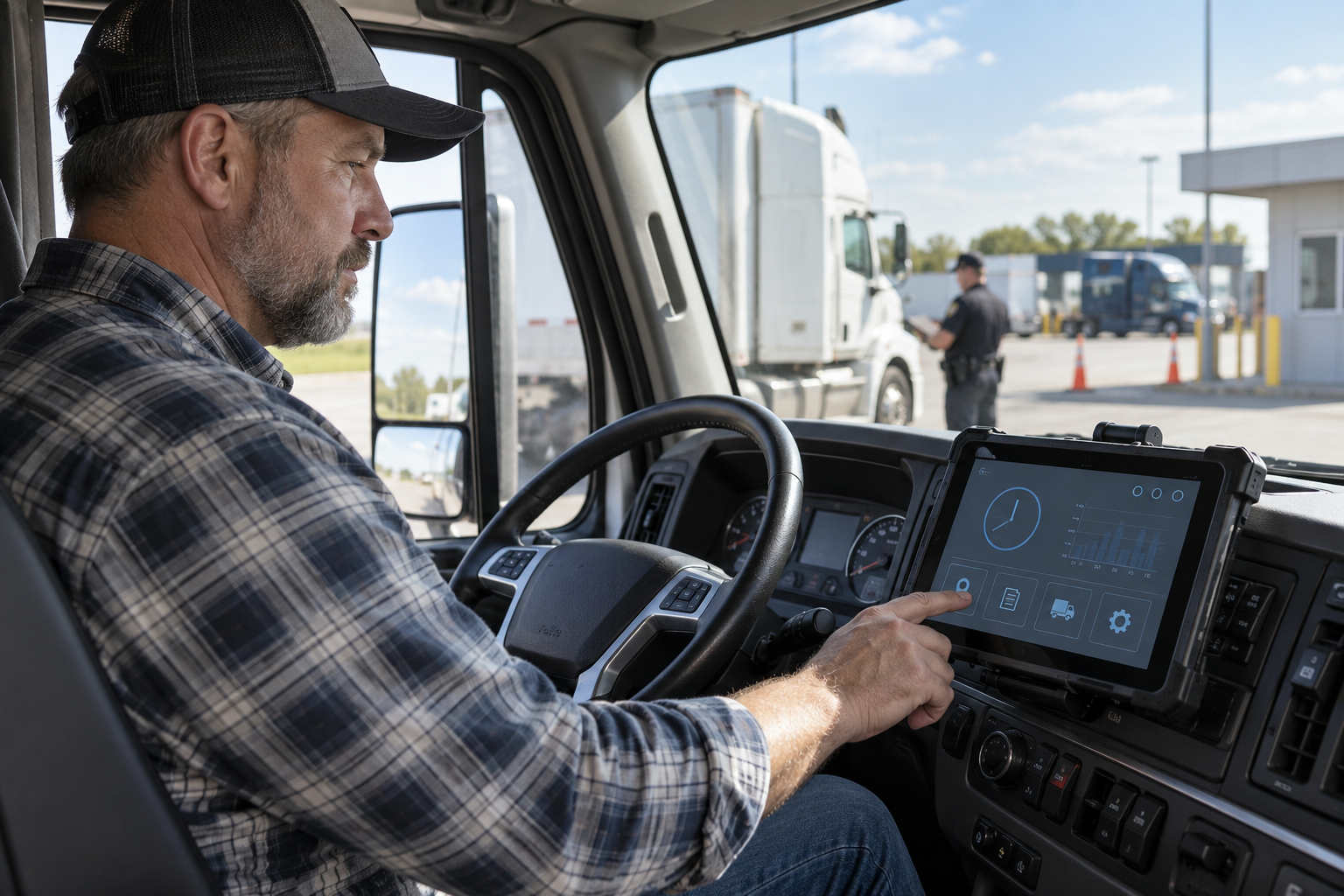
ELD Mandate Explained: Who Needs an ELD in 2026?
If you operate a commercial truck in the United States, you may already be required to use an Electronic Logging Device (ELD).
The ELD mandate applies to most motor carriers and drivers who are required to maintain Records of Duty Status (RODS) under the Federal Motor Carrier Safety Regulations. However, FMCSA rules include several specific exceptions for certain short-haul operations, older vehicles, drive-away/tow-away operations, and drivers who only need RODS for a limited number of days.
Understanding whether your operation falls under the ELD mandate is important. Using an ELD when you are exempt is generally allowed, but failing to use one when it is required can create compliance problems during a roadside inspection.
In this guide, we'll explain who needs an ELD in 2026, the main exemptions, and how to determine whether your truck or fleet needs an ELD.
What is the ELD mandate?
The Electronic Logging Device mandate requires most drivers who are subject to federal Hours of Service (HOS) recordkeeping requirements to use a registered ELD to record their duty status.
Instead of manually maintaining paper logs, an ELD records driving activity and other required duty-status information electronically.
According to the Federal Motor Carrier Safety Administration (FMCSA), the ELD rule applies to most motor carriers and drivers who are required to maintain RODS under 49 CFR Part 395.
The purpose of the rule is to create more accurate records of drivers' hours and make it easier for drivers, carriers, and safety officials to review HOS information.
Who needs an ELD in 2026?
In general, you need an ELD if:
- You operate a commercial motor vehicle subject to the federal HOS regulations.
- You are required to maintain Records of Duty Status (RODS).
- You do not qualify for one of the specific ELD exceptions.
- You operate in interstate commerce or otherwise fall under the applicable federal requirements.
The rule applies not only to trucking companies but also to certain commercial bus operations. FMCSA also states that Canada- and Mexico-domiciled drivers operating in the United States are subject to the ELD rule unless they qualify for an applicable exception.
Simple way to think about it
If your operation requires you to keep RODS and no ELD exception applies, you generally need to use an ELD.
The key question is therefore not simply:
"Do I drive a truck?"
The more important question is:
"Am I required to keep RODS under the HOS rules?"
If the answer is yes, you should determine whether one of the ELD exceptions applies to your operation.
Who is exempt from the ELD mandate?
FMCSA provides several exceptions. The most common ones include:
- Short-haul operations that qualify for the applicable time-record exception
- Drivers who use RODS no more than 8 days in any 30-day period
- Certain drive-away/tow-away operations
- Drivers operating vehicles manufactured before model year 2000
There are also specific HOS exemptions for certain agricultural operations and other specialized circumstances.
Let's look at the main ELD exceptions in more detail.
1. Short-haul drivers
One of the most important exceptions is the short-haul exception.
Certain drivers who meet the short-haul requirements can use time records instead of RODS and therefore do not have to use an ELD.
For example, FMCSA's HOS guidance describes a short-haul exception for qualifying drivers who operate within a specified air-mile radius of their normal work reporting location and return to that location within the applicable duty period.
For qualifying CDL drivers, the commonly applicable short-haul radius is 100 air miles with a maximum 12-hour duty period.
For certain non-CDL operations, the applicable short-haul exception can extend to 150 air miles with a 14-hour duty period.
However, the short-haul exception has several conditions. Simply operating locally does not automatically mean you are exempt.
If you regularly exceed the requirements of the applicable short-haul exception, you may need to maintain RODS and use an ELD unless another exception applies.
2. The 8-days-in-30-days exception
Some drivers are not required to use an ELD if they are required to keep RODS for no more than 8 days during any 30-day period.
This is a rolling 30-day period, not necessarily a calendar month.
For example, a carrier should not simply count the number of days driven during January. The relevant question is whether the driver is required to maintain RODS on more than 8 days during any 30-day period.
Drivers who qualify for this exception may still need to prepare RODS on the days when they are not exempt.
Important:
The 8-day exception does not mean that a driver can operate indefinitely without an ELD as long as they occasionally use paper logs.
If the driver exceeds the applicable limit, the ELD requirement may apply unless another exception covers the operation.
3. Vehicles manufactured before model year 2000
Vehicles manufactured before model year 2000 are another major ELD exception.
FMCSA states that drivers of vehicles manufactured before model year 2000 are not required to use an ELD, although carriers may voluntarily use one.
There is an important detail here.
The relevant vehicle or engine information can matter when determining whether the exception applies. FMCSA guidance addresses situations involving vehicles with model-year or engine documentation that may differ.
If you believe your truck qualifies because of its age, verify the vehicle information and applicable FMCSA requirements rather than relying only on the year displayed in a listing or sales advertisement.
4. Drive-away/tow-away operations
Certain drive-away/tow-away operations are also exempt from the ELD requirement.
This generally applies when the vehicle being driven is itself the commodity being delivered, or in qualifying operations involving a motor home or recreational vehicle trailer.
For example, moving a vehicle as part of a qualifying drive-away/tow-away operation can fall under the exception.
However, not every vehicle movement qualifies.
The exact circumstances of the transportation matter, so carriers should verify that the operation meets the regulatory definition before relying on this exception.
5. Agricultural exemptions
Agricultural operations can have additional HOS and ELD exemptions.
FMCSA provides specific guidance for the transportation of agricultural commodities within a 150 air-mile radius from the source during applicable planting and harvesting periods.
When the agricultural exemption applies, the HOS rules and ELD requirements may not apply within the qualifying area.
There are additional requirements and limitations, so agricultural carriers should review the specific FMCSA rules that apply to their operation.
Once a driver operates outside the applicable agricultural exemption area, the normal HOS and ELD requirements can apply unless another exception is available.
Does every truck over 10,000 pounds need an ELD?
Not necessarily.
Vehicle weight alone does not determine whether an ELD is required.
FMCSA's rules consider whether the vehicle and operation are subject to the applicable HOS requirements and whether the driver is required to maintain RODS.
For example, FMCSA notes that certain vehicles between 10,001 and 26,000 pounds may require an ELD to complete RODS even though a CDL may not be required. Vehicles at or above 26,001 pounds may fall under both CDL and HOS requirements depending on the operation.
This is why determining ELD applicability based only on truck weight can be misleading.
Do owner-operators need an ELD?
An owner-operator may need an ELD if their operation is subject to the federal HOS recordkeeping requirements and no ELD exception applies.
Being an owner-operator does not automatically exempt a driver from the ELD mandate.
The same basic questions apply:
- Are you required to maintain RODS?
- Do you qualify for a short-haul exception?
- Do you use RODS no more than 8 days in a 30-day period?
- Is the vehicle manufactured before model year 2000?
- Does your operation qualify as drive-away/tow-away?
- Does another specific exemption apply?
If none of the applicable exceptions apply, an ELD may be required.
Do small trucking companies need an ELD?
Yes, company size by itself does not create an exemption.
A one-truck operation can be subject to the ELD rule just like a fleet with hundreds of trucks.
If the driver is required to maintain RODS and does not qualify for an ELD exception, the operation generally needs a compliant ELD.
This means small carriers should not assume that the ELD mandate only applies to large fleets.
Do local truck drivers need an ELD?
It depends on the operation.
A driver who works locally may qualify for a short-haul exception. But simply staying close to home does not automatically eliminate the ELD requirement.
The carrier needs to verify whether the driver meets all requirements of the applicable short-haul exception, including the relevant radius, duty-period, and return-to-reporting-location requirements.
If those requirements are not met, the driver may need to maintain RODS and use an ELD.
Do leased trucks need an ELD?
Leasing a truck does not by itself determine whether an ELD is required.
The requirement generally depends on the operation, driver, vehicle, and applicable HOS/ELD rules.
If the leased vehicle is being operated in a manner that requires RODS and no exception applies, the carrier should use a compliant ELD.
What happens if a carrier uses a non-compliant ELD?
If an ELD is required, the carrier should use a device that is registered with FMCSA.
FMCSA states that motor carriers and drivers should choose ELDs that are certified and registered on the FMCSA website.
The official FMCSA ELD website provides the current list of registered, self-certified devices.
FMCSA also maintains information about devices that have been removed from the registered list.
This is important because an ELD that was previously registered may later be removed from the list.
Before choosing an ELD, check:
- Is the provider listed by FMCSA?
- Is the specific device registered?
- Is the device currently on the registered list?
- Does the device support the features your operation requires?
- Does the provider provide the required documentation and support?
Do not rely solely on an ELD company's marketing claim that its product is "FMCSA compliant."
Check the official FMCSA registration list.
How can carriers check whether an ELD is registered?
FMCSA maintains an official list of registered ELDs.
Carriers can use the FMCSA ELD website to verify whether a device is currently registered.
This check is particularly important before purchasing an ELD and whenever FMCSA announces that devices have been removed from the registered list.
Official FMCSA ELD resource:
https://eld.fmcsa.dot.gov/
What should carriers do if they are unsure?
If you're not sure whether your operation requires an ELD, don't make the decision based on a single factor such as truck size, mileage, or whether you are an owner-operator.
Review the complete operation:
Step 1: Determine whether HOS rules apply
Confirm that the vehicle and operation fall under the applicable federal HOS requirements.
Step 2: Determine whether RODS are required
If you are required to maintain RODS, continue to the next step.
Step 3: Check for ELD exceptions
Review:
- Short-haul exceptions
- 8-days-in-30-days exception
- Pre-model-year-2000 vehicle exception
- Drive-away/tow-away exception
- Agricultural exemptions
- Other applicable regulatory exemptions
Step 4: Verify your ELD
If an ELD is required, make sure the device is currently registered with FMCSA.
Step 5: Keep your compliance information organized
Drivers and fleet managers should know which rules and exemptions apply to each operation.
This becomes particularly important during roadside inspections.
How Unity ELD can help
For carriers that need an ELD, choosing the right system is only part of compliance.
The ELD should fit the way your drivers and fleet actually operate.
Unity ELD provides electronic logging and fleet management tools designed to help carriers manage driver hours, vehicle activity, and compliance information from one platform.
Instead of relying on paper records and disconnected systems, fleet managers can use an ELD platform to keep driver and vehicle information organized and easier to monitor.
For fleets with multiple trucks, centralized visibility can also make it easier to identify potential HOS issues before they become larger compliance problems.
ELD mandate FAQ
Is an ELD required for every commercial truck?
No. Most drivers required to maintain RODS must use an ELD, but FMCSA provides specific exceptions.
Can I use paper logs instead of an ELD?
In certain circumstances, yes. For example, drivers who are required to keep RODS no more than 8 days during a 30-day period may qualify for an ELD exception. Other exceptions may also apply.
Does an owner-operator need an ELD?
An owner-operator needs an ELD if the operation is subject to the ELD rule and no applicable exception applies.
Does a local driver need an ELD?
Not necessarily. A qualifying short-haul operation may be exempt from using an ELD.
Are trucks manufactured before 2000 exempt?
Generally, yes. FMCSA lists vehicles manufactured before model year 2000 among the ELD exceptions.
Can I voluntarily use an ELD if I am exempt?
Yes. FMCSA states that carriers may choose to use an ELD even when an operation qualifies for an exception.
Where can I check whether an ELD is registered?
Use the official FMCSA ELD website and its Registered ELD list:
Final takeaway
The ELD mandate applies to most commercial drivers who are required to maintain Records of Duty Status under the federal HOS regulations.
However, not every driver needs an ELD.
Short-haul operations, drivers who use RODS no more than 8 days in a 30-day period, qualifying drive-away/tow-away operations, pre-model-year-2000 vehicles, and certain agricultural operations may qualify for exceptions.
The safest approach is to determine whether your specific operation requires RODS, review the applicable ELD exceptions, and verify that your device is currently registered with FMCSA.
For carriers that do need an ELD, choosing a registered and reliable system is an important part of maintaining day-to-day compliance.