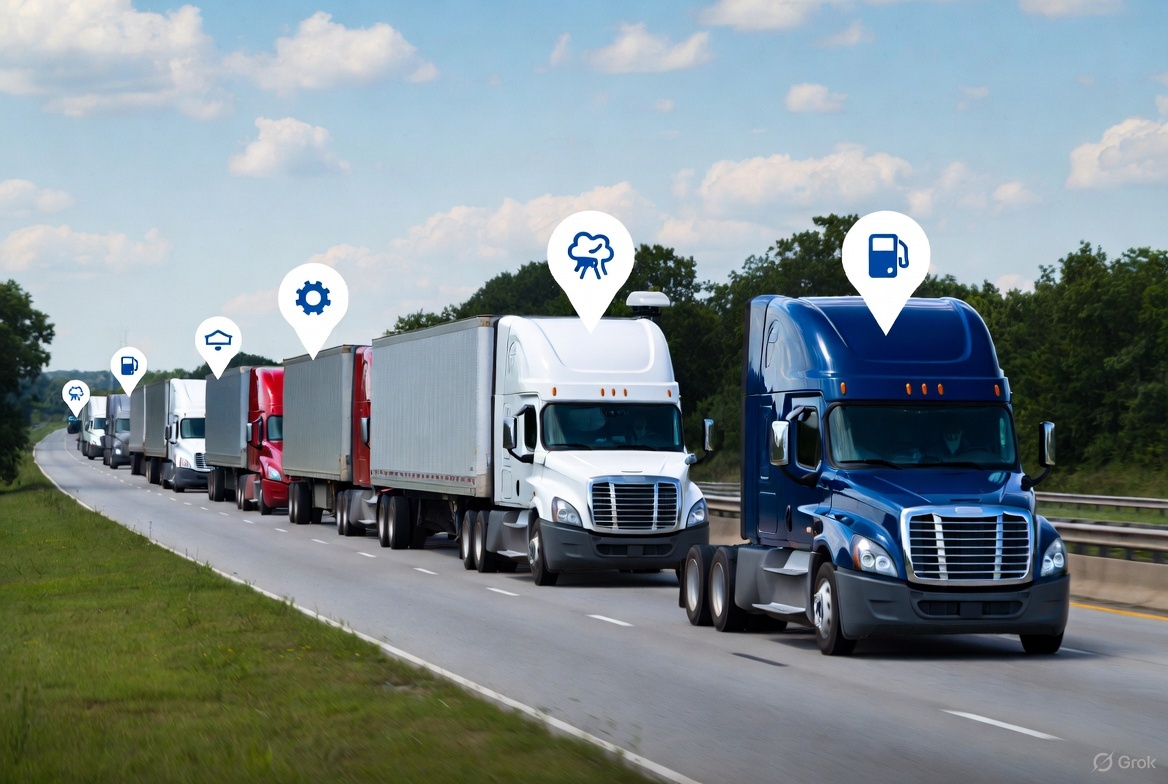
The “habitual” route costs too much today: fuel, empty miles, delays, and HOS violations. Route optimization software helps fleets build routes so trucks drive less while earning more. Modern solutions account for not only distance, but real road conditions, driver limits, and delivery windows—turning chaotic planning into a predictable system of savings.
Factors affecting route efficiency
Route efficiency is impacted by many factors dispatchers often underestimate:
- Traffic and seasonality. In winter, routes change daily due to snow, ice, and road closures. In summer—due to construction and tourist traffic.
- HOS restrictions. Even a perfect route on the map can be impossible if the driver is running out of allowed driving time.
- Empty miles and deadhead returns. One of the most expensive factors—returning empty or long repositioning to the next load.
Delivery windows and late penalties. Strict receiver time slots force a choice between speed and safety.
Strategies to improve routing
To increase efficiency, use proven approaches:
- Plan with HOS in mind. Link route optimization to the driver’s current shift limits—this prevents violations and forced downtime.
- Reduce empty miles with backhaul templates. Build databases of regular return loads and pre-match backhauls.
- Optimize multi-stop routes by delivery-window priority. Start with strict windows, then flexible ones—this minimizes waiting and penalties.
- Compare “plan vs actual.” Without regular deviation analysis, the same mistakes repeat.
Give the driver a transparent route. A clear plan with understandable reasons for stop sequencing reduces unauthorized deviations and builds trust.
Technology and innovations
Modern technology makes route optimization truly intelligent. Unity ELD enhances any route optimization solution by adding critical real-time data:
- Real-time HOS remaining → routes automatically adjust to driver limits, eliminating unrealistic plans.
- GPS data and actual stops help refine ETA models, making arrival predictions more accurate with every trip.
- Deviation reports reveal where optimization fails to account for real-world conditions, enabling quick algorithm adjustments.
Integrating dispatching systems with ELD turns a static map into a dynamic model that responds to traffic, weather, and driver status.
Route optimization software is not just a “shorter map”—it’s a comprehensive system for saving minutes, miles, and fuel. Paired with Unity ELD, you get routes that are not only efficient on paper but realistically achievable within HOS limits, road conditions, and delivery windows. The result: lower costs, higher productivity, and satisfied drivers.
Route optimization software FAQs
Does route optimization reduce fuel costs?
Yes—because it cuts empty miles, unnecessary detours, and idle time in traffic. Savings are especially noticeable on LTL and multi-stop routes, where manual planning often leaves 10–20% “extra” mileage.
Why connect routing with ELD?
Without current HOS data, a route can be impossible: the driver won’t make it or will violate regulations. Unity ELD feeds accurate remaining driving and rest time into the optimization system, reducing the risk of violations to near zero and helping protect against FMCSA fines.