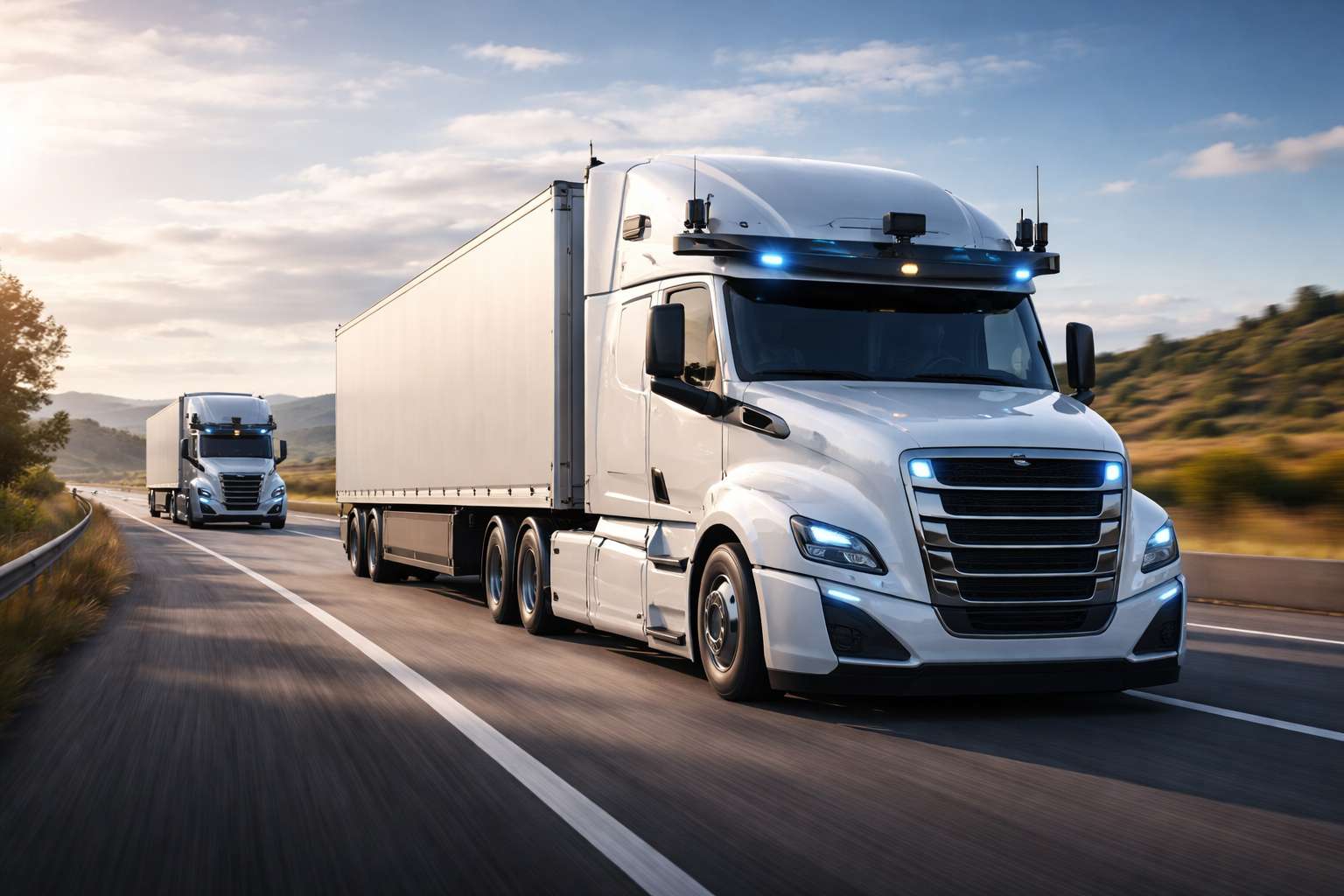
Moving from pilots to full-scale operations
The U.S. trucking industry is entering new phase. This time, the key driver isn’t just technology - it’s regulation.
With the SELF DRIVE Act 2026, the logistics landscape is set for major changes:
- Self-certification: Companies developing autonomous trucks can now certify their solutions independently.
- Faster deployment: Autonomous trucks will hit the roads more quickly and safely.
- Reduced regulatory pressure: Easier scaling for businesses embracing innovation.
Meanwhile, the U.S. Congress is considering broader access for driverless trucks on public roads, paving the way for full commercial adoption.
The industry is shifting from experimental programs to real-world operations. Today, the question is no longer “Can the truck drive itself?” but “Can it operate efficiently across a full logistics network?”
This evolution is prompting companies to rethink logistics strategies:
- Route optimization: Autonomous trucks rely on AI-driven routing algorithms to reduce delivery times and fuel costs.
- Dynamic scheduling: Fleets can respond in real-time to demand fluctuations and traffic conditions.
- Network integration: Self-driving trucks can be seamlessly integrated with warehouses, hubs, and last-mile delivery operations.
The transformation is not just operational - it’s cultural. Fleet managers are learning to trust AI systems, and logistics teams are adapting to a hybrid model of human and automated workflows.
The evolving role of ELD and fleet management
Autonomous trucks are redefining how Electronic Logging Devices (ELDs) and fleet management systems operate:
- Less reliance on driver logs - Automation reduces manual reporting and human error.
- Data-driven decisions - Real-time insights and predictive analytics enable smarter maintenance, route planning, and fuel management.
- Enhanced fleet visibility - Continuous monitoring ensures safer, more efficient operations across large networks.
- Predictive maintenance - Sensors and AI can detect potential mechanical issues before they cause downtime.
- Safety compliance - Automated systems ensure adherence to hours-of-service rules and regulatory requirements without manual intervention.
For businesses, this shift means rethinking compliance strategies and retraining teams to manage a technology-driven fleet efficiently.
Economic and market implications
The adoption of autonomous trucks will have far-reaching effects on the logistics industry:
- Cost efficiency: Reduced labor costs and optimized fuel usage improve profitability.
- Increased capacity: 24/7 operations enable faster throughput without driver fatigue limitations.
- Competitive differentiation: Early adopters can offer faster, more reliable shipping services.
- Market consolidation: Smaller companies may struggle to adopt AI-driven fleets, encouraging partnerships and acquisitions.
Investors are already taking notice, with venture capital flowing into startups focused on autonomous trucking software, sensors, and fleet integration tools.
Unity ELD: Embracing the future of logistics
At Unity ELD, we view this transformation as an opportunity, not a threat:
- AI-powered solutions – Our platform helps fleets manage both autonomous and traditional vehicles.
- Seamless integration – Unity ELD connects autonomous trucks with dispatch, telematics, and driver support systems.
- Real-time insights – Advanced analytics allow managers to make proactive decisions.
- Compliance made easy – Automated logging and reporting reduce administrative burdens and regulatory risk.
Businesses that embrace autonomous trucking now will gain significant competitive advantage, while those who wait risk falling behind.
Preparing for the autonomous era
The transition is happening faster than many expect. Logistics leaders should focus on:
- Evaluating AI-driven fleet management solutions.
- Training staff for hybrid human-automation operations.
- Piloting autonomous integration in controlled networks.
- Leveraging predictive analytics for safety and efficiency.
The future of logistics is already here. The question is not if autonomous trucks will dominate, but how quickly your business can adapt.