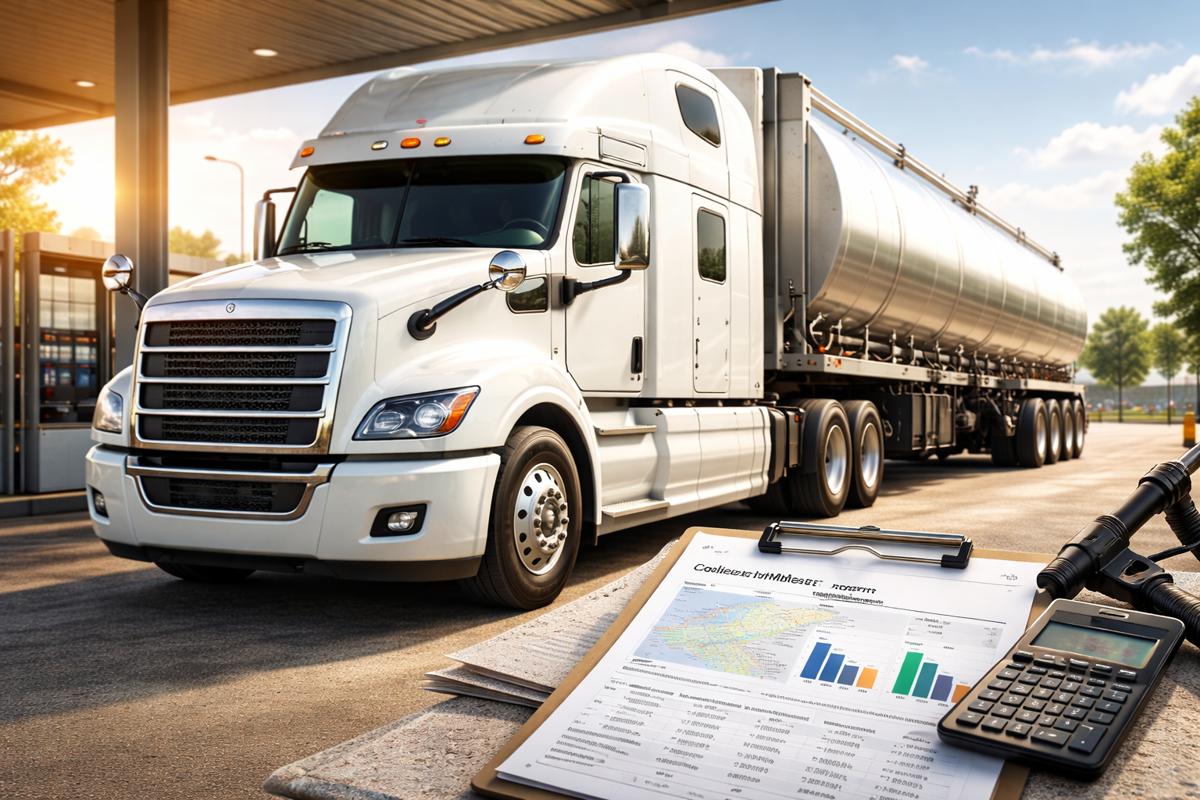
What is IFTA and why it matters
The International fuel tax agreement (IFTA) is a tax reporting system used by U.S. states and Canadian provinces to simplify fuel tax collection for interstate carriers.
Instead of filing separate fuel tax reports in every jurisdiction, carriers submit one quarterly report to their base state.
The state then distributes the tax revenue to other jurisdictions based on where the miles were driven.
IFTA reporting requires fleets to track:
- Total miles driven in each jurisdiction
- Total fuel purchased
- Fuel purchased per jurisdiction
- Average fuel economy (MPG)
- Tax owed or refunded
For fleets operating in multiple states, accurate mileage tracking is essential.
The problem with manual IFTA calculations
Many small carriers still calculate IFTA reports using:
- driver trip sheets
- manual odometer readings
- spreadsheets
- fuel receipts
This approach creates several common problems.
Human error
Drivers may forget to record exact mileage by state or make mistakes when filling out trip reports.
Even small errors can affect tax calculations.
Missing jurisdiction data
Without automated tracking, it is difficult to accurately determine how many miles were driven in each state.
This can result in incorrect tax payments or penalties.
Time-consuming calculations
Fleet managers often spend hours or even days collecting:
- fuel receipts
- driver logs
- mileage reports
Then they manually calculate tax obligations for each jurisdiction.
Higher Audit Risk
IFTA audits require carriers to provide detailed records of mileage and fuel purchases.
Incomplete or inaccurate documentation can result in fines or additional tax assessments.
How ELD systems simplify IFTA reporting
Modern ELD platforms automatically collect many of the data points required for IFTA reports.
Because ELD devices track vehicle movement through GPS and engine data, they can accurately record mileage across state lines.
This automation significantly reduces manual work.
Automatic mileage tracking
ELD systems record:
- vehicle location
- miles driven
- state crossings
This allows fleets to generate jurisdiction-based mileage reports automatically.
Instead of relying on driver input, the system calculates miles per state in real time.
Integrated fuel tracking
Many ELD platforms also allow fleets to log fuel purchases.
When combined with mileage data, the system can automatically calculate:
- fuel economy
- fuel consumed per jurisdiction
- potential tax obligations
This removes the need for complex spreadsheets.
Ready-to-export IFTA reports
With automated data collection, fleets can generate quarterly IFTA reports in minutes instead of hours.
Reports typically include:
- miles by jurisdiction
- fuel purchases
- total taxable gallons
- tax owed or refundable
These reports can be exported and used directly for filing.
The role of automation in 2026
In recent years, fleet management technology has moved beyond simple logging devices.
Modern systems now include analytics and automation tools that help fleets manage compliance tasks more efficiently.
For fuel tax reporting, automation offers several advantages.
Faster reporting
Instead of collecting data manually at the end of the quarter, fleets already have the information organized and ready to review.
Reduced compliance risk
Automated mileage tracking helps ensure that jurisdiction data is accurate and consistent.
This lowers the risk of filing incorrect reports.
Better financial visibility
Fleet managers can monitor fuel usage trends, fuel efficiency, and operational costs more clearly.
This data can support better decision-making beyond tax reporting.
Key reports fleets should monitor
To prepare for quarterly IFTA filings, fleets should regularly review several key reports.
Jurisdiction mileage report
Shows how many miles were driven in each state or province.
Fuel purchase report
Tracks fuel receipts and purchases by location and date.
Fuel economy report
Calculates miles per gallon (MPG) across the fleet.
Vehicle performance report
Helps identify trucks that consume more fuel than expected.
Monitoring these reports throughout the quarter helps prevent last-minute surprises.
Example: How automation saves time
Consider a small fleet operating 8 trucks across several states.
Using manual methods, quarterly IFTA reporting might require:
- collecting driver trip sheets
- reviewing fuel receipts
- calculating miles by state
- verifying totals
This process can take 6–10 hours per quarter.
With automated ELD reporting:
- mileage is recorded automatically
- fuel data is stored digitally
- jurisdiction reports are generated instantly
The entire review process may take less than 30 minutes.
Common mistakes fleets make with IFTA
Even with modern technology, fleets sometimes run into issues when preparing fuel tax reports.
Some of the most common mistakes include:
- forgetting to log fuel purchases
- failing to review jurisdiction reports regularly
- relying on incomplete driver records
- not maintaining backup documentation
Regularly reviewing ELD reports throughout the quarter helps avoid these problems.
Turning compliance into operational advantage
While IFTA reporting is primarily a compliance requirement, the data collected during the process can also improve fleet operations.
Fuel reports can reveal:
- inefficient routes
- excessive idle time
- underperforming vehicles
When analyzed properly, this data helps fleets reduce costs and improve efficiency.
Final thoughts
IFTA reporting does not have to be a stressful quarterly task.
By using modern ELD systems that automatically collect mileage and fuel data, small fleets can simplify the reporting process, reduce errors, and spend less time on paperwork.
Automation transforms IFTA from a manual accounting exercise into a streamlined compliance workflow.
For growing fleets, that means more time focusing on operations and less time managing spreadsheets.
Want to simplify your IFTA reporting?
Modern ELD systems can automatically track jurisdiction mileage, organize fuel data, and generate ready-to-use reports for quarterly filings.
If you'd like to see how automated reporting can simplify compliance for your fleet, leave your email and learn how Unity ELD helps carriers manage HOS, inspections, and fuel reporting in one platform.